As an Amazon Associate we earn from qualifying purchases. Learn more.
How to Keep Devices Charged on Multi-Day Campsites (2026 Guide)
Running out of battery on day two of a multi-day campsite is maddening: no maps, no music, no emergency comms. This guide is for campers who want dependable, lightweight ways to keep phones, cameras, GPS units, and Bluetooth gear charged for several days without relying on campsite hookups. You’ll learn a practical system that combines power banks, portable solar, and charging kits, plus hands-on reasons each product made our list. Products were selected for their real-world camping features—capacity, charging speed, portability, built-in cables, and ruggedness—then ordered by how well they solve the multi-day charging problem.
Quick Answer
Use a mix of a high-capacity power bank with PD output and wireless pad (top pick: Jinepin 38600mAh) plus a compact solar recharger or hand-crank kit for emergencies. Jinepin balances capacity, built-in cables, and rugged design to keep phones and small devices powered across several days.
Our Top Picks
Quick Comparison
Select 2-3 products to compare side-by-side
| Compare | Product | GearLark Score | Price Tier | Key Feature | Best For | Action |
|---|---|---|---|---|---|---|
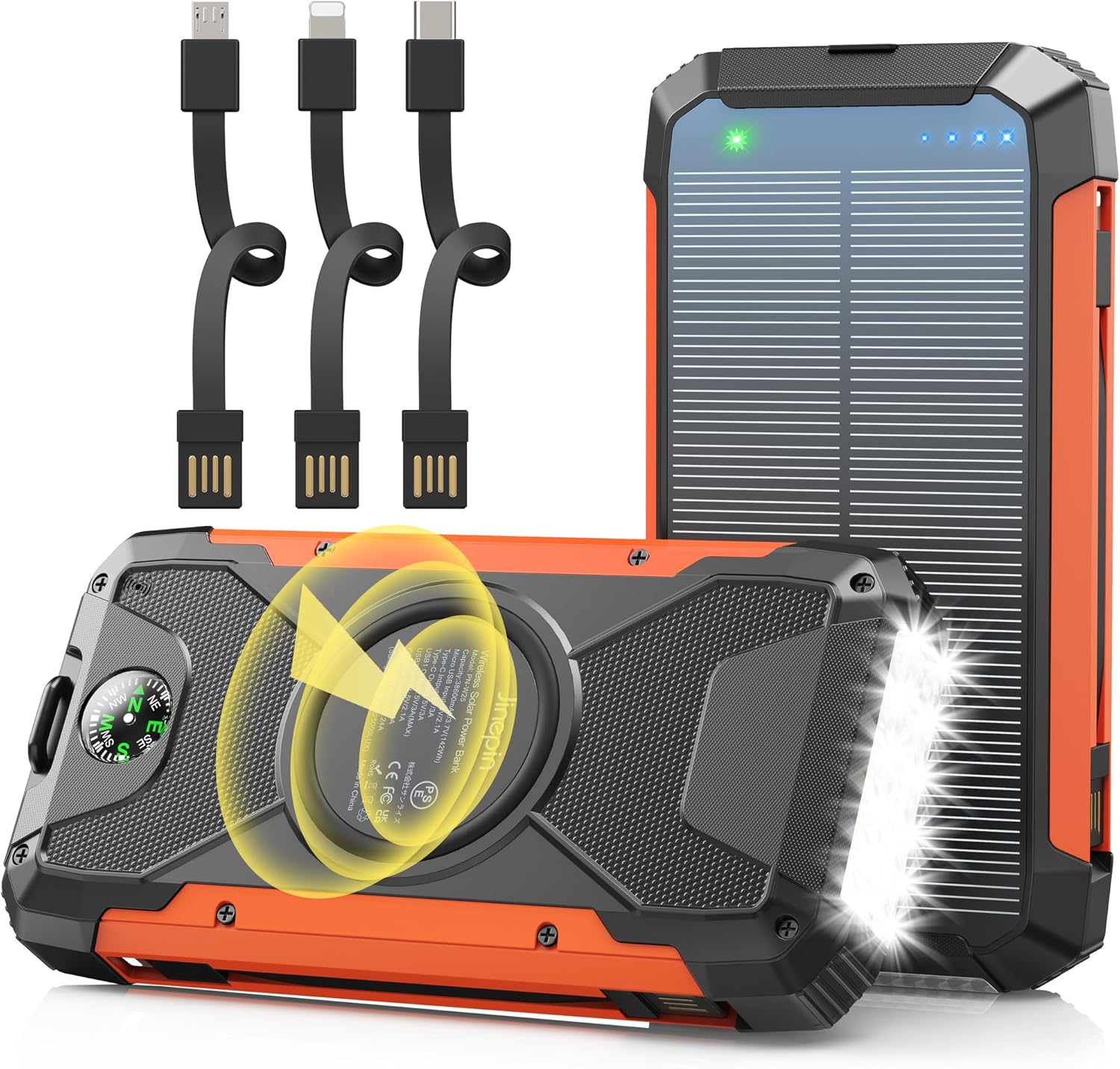 Jinepin 38600mAh Solar Bank
|
Budget | Built-in 3 cables + wireless | Lightweight multi-day campers | Check Price | ||
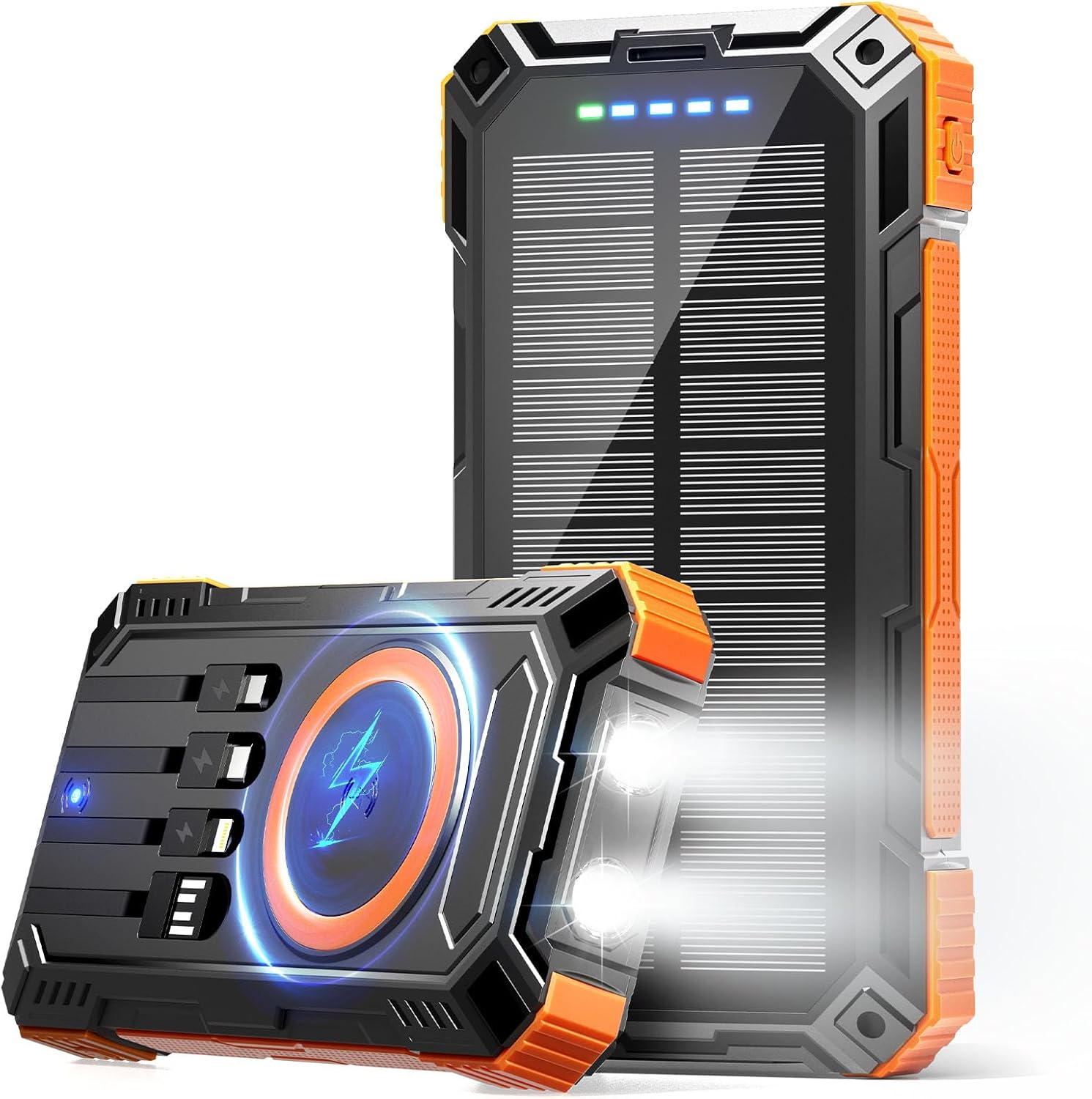 jskei 49800mAh Bank
|
Budget | 49800mAh with 5-device output | Groups needing many charges | Check Price | ||
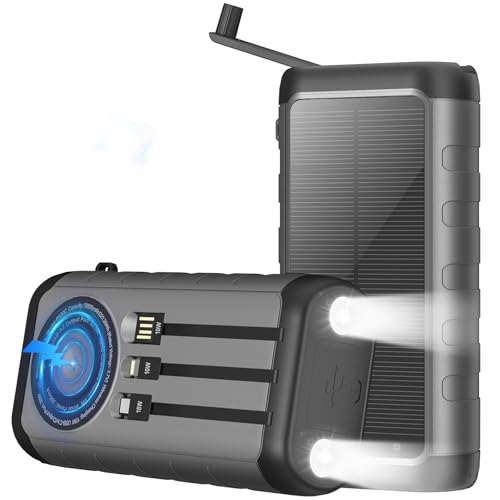 YELOMIN 59800mAh
|
Premium | Hand crank + 6 outputs | Family/group camping & emergencies | Check Price | ||
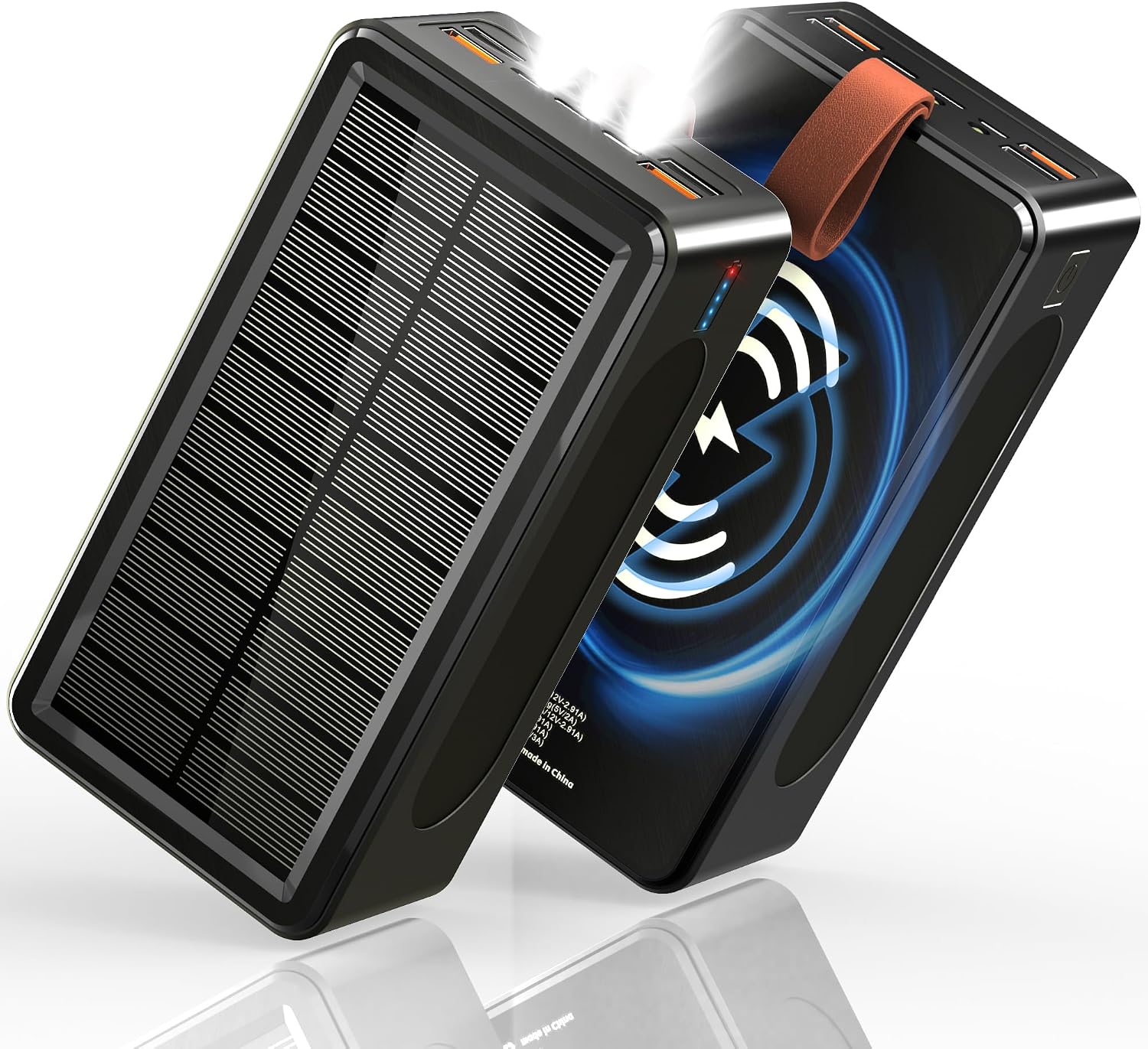 Feidyns 90000mAh
|
Premium | Huge 90,000mAh + 35W PD | Week-long trips & power-hungry gear | Check Price | ||
 DJKK 66800mAh Crank Bank
|
Premium | Hand crank + 5 outputs | Emergency-aware campers | Check Price |
1. Solar Charger 38600mAh,Solar Power Bank Wireless Portable Charger Built in 3 Cables External Battery Pack Waterproof with 4 Outputs 2 Inputs USB C 15 W 5V/3A Battery Bank with Camping Light Compass
Jinepin pairs a manageable 38,600 mAh capacity with built-in Lightning/USB-C/Micro cables and a wireless pad so you don’t need to hunt for chargers. It’s designed to hang on a pack to trickle from sun and doubles as a bright camping light—good balance of portability and real-world camping features.
Key Specs
- 38600mAh Li‑polymer battery
- Wireless charging pad
- 3 detachable charging cables (USB‑C, Lightning, Micro)
- LED camping light and compass
Pros
- Integrated cables prevent forgotten cords at the trailhead
- Wireless pad for convenient phone topping at camp
- Sturdy, weather-resistant shell built for outdoor use
Cons
- Still bulky compared with ultra-compact banks
- Solar panel is slow—best viewed as a trickle charger
Best For: Lightweight multi-day campers
Check Latest Price on Amazon2. Power Bank 49800mAh Solar Charger Wireless Charging USB-C 5V/3.1A Fast Charging with 4 Built-in Cables LED Flashlight Battery Pack Compatible with iPhone, iPad, Galaxy, Perfect for Camping, Hiking
jskei offers a big-capacity, value-focused bank with fast Type‑C output and wireless charging—suitable if you need to power several devices each day. Its rugged IP65 design and bright flashlight make it practical at camp; pair it with a small solar panel to extend multi-day use.
Key Specs
- 49800mAh high-density battery
- Type‑C 5V/3.1A fast output
- Wireless charging and 4 charging cables
- IP65 waterproof, LED flashlight with SOS
Pros
- Strong capacity at a budget price tier
- Fast USB‑C output shortens device top‑ups
- Rugged design and useful emergency light
Cons
- Solar recharging is slow—plan to precharge
- Weight can be noticeable for minimalist packs
Best For: Groups needing many charges
Check Latest Price on Amazon3. Solar Charger, 59800mAh Portable Power Bank for All Phones, Outdoor Waterproof Battery Pack Built in Hand Crank, 15W Wireless Charger 6 Outputs & 3 Inputs/LED Flashlights, Perfect for Camping Travel
YELOMIN’s 59,800 mAh bank focuses on versatility: wireless 15W charging, multiple outputs, and a built‑in hand crank for emergency juice. It solves multi‑day problems by giving you many simultaneous ports and redundancy when solar is weak.
Key Specs
- 59800mAh capacity
- 15W wireless charging
- Hand crank generator + 6 outputs
- Multiple input options and dual flashlights
Pros
- Lots of ports for charging multiple devices
- Hand crank adds emergency resilience
- Solid build and clear charging indicators
Cons
- Hand crank and solar are slow—primarily emergency use
- Heavier and bulkier than single-device banks
Best For: Family/group camping & emergencies
Check Latest Price on Amazon4. 90000mAh Power Bank 35W Fast Charging with Solar Charger - High Capacity Wireless Charger Power Bank for Camping, Travel, Emergencies, Tech Devices | 7-Port PD/USB-C, LED Flashlight
Feidyns packs a near‑generator capacity into a portable unit—90,000 mAh with 35W PD and seven output ports. For extended trips it reduces charging anxiety: you can top phones, tablets, and small laptops repeatedly, and robust IP66 protection handles rough weather.
Key Specs
- 90000mAh high-capacity battery
- 35W PD & QC 3.0 fast charging
- 15W wireless pad and 7 charging ports
- IP66 water/dust protection and 300‑lumen LED
Pros
- Massive capacity for many multi‑day charges
- High-speed PD shortens restore times
- Rugged, weather‑resistant build and survival features
Cons
- Very heavy and large for backpacking
- Solar input is emergency-grade only—not a main recharge
Best For: Week-long trips & power-hungry gear
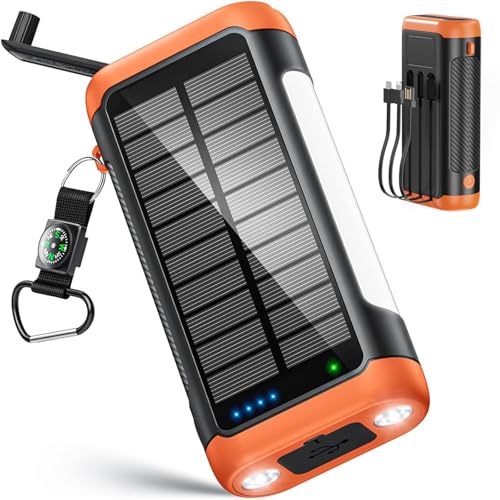
Check Latest Price on Amazon5. DJKK Solar Power Bank Portable Charger:66800mAh Built in Hand Crank and 3 Cables 22.5W Fast Charging Phone External Battery Pack(5 Outputs & 5 Inputs) with Camping Flashlights/Table Lamp/Compass
DJKK combines 66,800 mAh capacity with a hand crank and integrated cables so you have multiple recharge pathways away from shore power. Its table-lamp function and compass add campsite utility; ideal as an emergency backup that still supports daily top‑ups.
Key Specs
- 66800mAh capacity
- 22.5W max charging via USB A
- Built-in hand crank and 3 charging cables
- Camping lamp, flashlight, and compass included
Pros
- Hand crank and lamp increase off-grid resilience
- Multiple outputs and inputs for flexible recharging
- Hard-wearing ABS shell for outdoor use
Cons
- Hand crank and solar produce only limited power
- Larger footprint and weight vs smaller banks
Best For: Emergency-aware campers
Check Latest Price on AmazonWhich One Should You Choose?
If budget is tight → choose jskei 49800mAh for the best blend of capacity and price. If you need portable convenience → choose Jinepin 38600mAh for built-in cables and wireless charging. If premium capacity and durability matter → choose Feidyns 90000mAh for maximum runtime and rugged features.
Best for Specific Scenarios
- Solo lightweight backpacking: Jinepin 38600mAh because the built-in cables, wireless pad, and pack-hang lanyard cut down what you carry while giving multiple useful charges.
- Group/basecamp trips: jskei 49800mAh (or YELOMIN 59800mAh for larger groups) because multiple outputs and higher capacity support several devices daily.
- Emergency-resilient setups: Feidyns 90000mAh or DJKK 66800mAh because large capacity, hand-crank/robust survival features, and rugged IP protection give you redundancy when solar or outlets are unreliable.
Frequently Asked Questions
How much battery capacity do I need for a 3–5 day campsite trip?
Estimate your average daily device use (phones, GPS, cameras). A mid-range smartphone typically needs 1–2 full charges per day; multiply that by days and add a safety buffer. For solo campers a 30k–50k mAh bank usually covers phones for multiple days; for groups or heavier device use, 50k–90k mAh is safer.
Can I rely on a power bank’s built-in solar panel to recharge fully during a trip?
Built-in solar on most banks is best treated as an emergency trickle charger; it extends runtime but won’t fully recharge large banks in one day unless conditions are ideal and panels are large. For dependable recharging, bring a dedicated 18–30W foldable solar panel that matches your bank’s input specs.
Should I prioritize wireless charging or USB‑C PD for camping?
Prioritize USB‑C PD for efficiency and speed—wired PD charges faster and wastes less energy. Keep wireless as a convenience feature for quick top-ups at camp. If packing space is tight, a bank that offers both gives the best flexibility.
How We Selected These Products
Our recommendations are based on data-driven analysis: we evaluated 155229+ products across 23916+ brands using a composite scoring system that weighs rating (40%), review volume (30%), price value (20%), and demand signals (10%). Every product is ranked by data, not opinions.
Last updated: July 05, 2026
As an Amazon Associate we earn from qualifying purchases at no extra cost to you. Full disclosure.
GearLark Score is our editorial ranking based on a composite analysis of product quality, value, and verified customer sentiment. Click through to Amazon for current pricing, availability, and live customer reviews.